Some worries arrive loudly — a fall, a fever, a scary cough. Developmental worry is quieter. It's the thought that surfaces at the playground when another toddler is chattering away and yours isn't, or the small note in the back of your mind that your baby used to babble and somehow stopped. It's easy to talk yourself out of that feeling. Please don't.
This is the post that ties every milestone guide together: how to tell an ordinary "wide range of normal" from a genuine red flag, and exactly what to do about it. The single most important thing to know is that you have more power here than you think — in the US, you can get your child a free developmental evaluation yourself, today, without a doctor's referral or a diagnosis.
What the science says: act early, because brains are most adaptable early
Developmental milestones describe what most children do by a certain age — the CDC builds its checklists around things 75% or more of children can do, which means a quarter of perfectly healthy kids haven't yet (CDC). So a single late milestone, with steady forward progress, is usually just the wide-range-of-normal at work. We've written about why milestones beat ages precisely because the calendar lies.
But "ranges, not deadlines" is not the same as "wait and see." The CDC is direct about this: if you have a concern, don't wait — acting early can make a real difference (CDC). The reason is biological. A young child's brain forms connections faster in the first few years than at any later point, which is exactly why support started early tends to work better and can change a child's developmental path (CDC). Early help isn't about labeling a child sooner. It's about catching the window when the brain is most ready to respond.
The system that makes this work is two layers. Developmental monitoring is the watching you and your pediatrician already do — noticing how your child plays, learns, speaks, acts, and moves over time. Developmental screening is a closer, more formal look using a validated questionnaire. The AAP recommends a screening at the 9-, 18-, and 30-month visits, plus autism-specific screening at 18 and 24 months — and any time a parent or provider has a concern (CDC). That "any time you have a concern" clause is the important one. You don't have to wait for the calendar to come around.
The red flags worth acting on
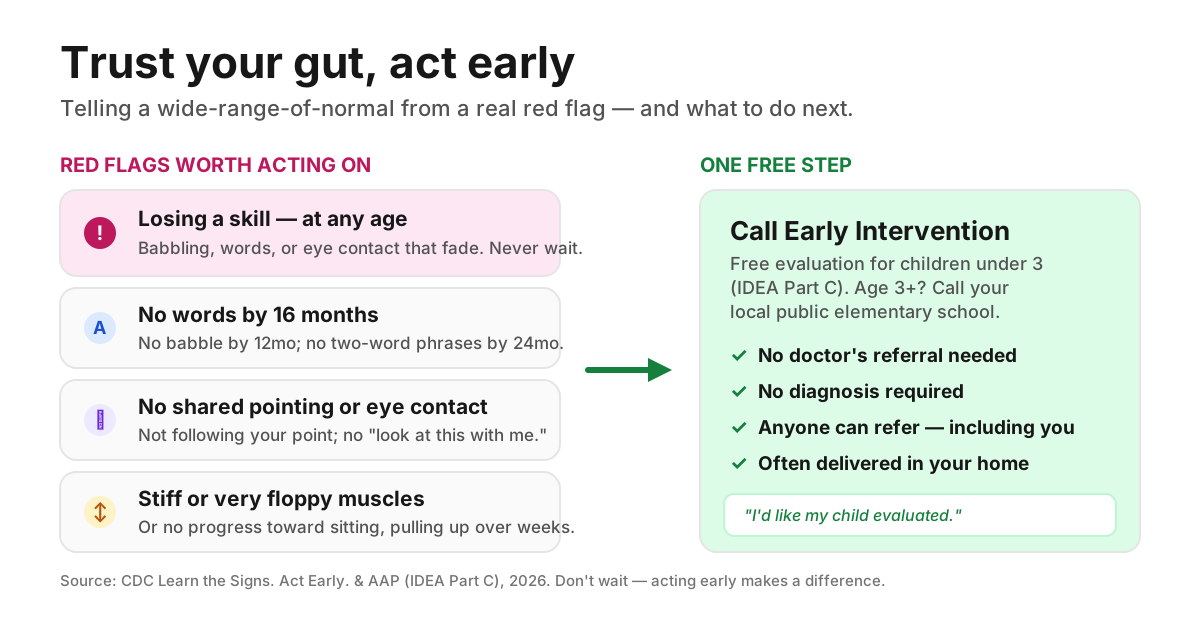
Most of what looks "behind" isn't. But some signs are different in kind, not just degree — they're worth a prompt call to your pediatrician rather than another month of watching. The clearest ones:
At any age: losing a skill
This is the big one. If your child stops doing something they used to do — babbling that goes quiet, words that disappear, waving or pointing that fades, eye contact that drops off — call your pediatrician promptly. Loss of previously acquired skills at any age always warrants a conversation, never a wait. It is the single red flag that should never be filed under "give it time."
Social and communication signs
These are the ones parents most often second-guess, and the ones early support helps most:
- No babbling ("bababa," "dadada") by around 12 months
- No single words by around 16 months
- No two-word phrases ("more milk," "bye dada") by around 24 months
- Not responding to their name, or not seeming to hear sounds, as they get older
- Little or no eye contact, and no shared attention — not pointing to show you things, not following your point or gaze, not bringing a toy over to share. This back-and-forth ("look at that with me") is called joint attention, and its absence is one of the more meaningful early signs.
Motor and physical signs
- Stiff, tight muscles or, at the opposite extreme, a very floppy body
- Strong, persistent preference for one hand before the first birthday (true hand dominance usually doesn't appear until well into toddlerhood)
- Not bearing weight on legs, or not making progress toward sitting, pulling up, and moving over a stretch of weeks
A useful rule of thumb: one of these in isolation, with a happy, progressing child, is a reason to ask, not to panic. A cluster of them, or any loss of skills, is a reason to call sooner rather than later. Either way — and this is the whole point — asking is free and harmless. Your gut counts as data. The CDC's own advice when you call is refreshingly plain: you can simply say, "I am concerned about my child's development."
How to actually get help (the part nobody explains)
Here's the thing most parents don't know, and it changes everything: you don't need a doctor to be the gatekeeper.
If your child is under 3: Early Intervention
Every US state runs an Early Intervention program — services and support for babies and young children with developmental delays or disabilities, and their families. It exists because of a federal law: Part C of the Individuals with Disabilities Education Act (IDEA) (AAP). The four things to know:
- You can self-refer. Anyone can refer a child — pediatrician, parent, grandparent, child-care provider. A doctor's referral is not necessary, and you do not need a diagnosis first (CDC).
- The evaluation is free. Publicly funded programs evaluate any child who may be eligible at no cost, and many provide ongoing services free or at reduced cost (CDC).
- Eligibility is based on the evaluation, not on a label. The program assesses your child's skills and abilities to decide what, if anything, would help — common services are speech, physical, and occupational therapy, frequently delivered right in your own home.
- It's a phone call. Find your state's program (search "[your state] early intervention," or your pediatrician can hand you the number) and say: "I have concerns about my child's development and I would like to have my child evaluated."
If your child is 3 or older
The free help doesn't stop at 3 — it changes addresses. Around the third birthday, responsibility shifts from Early Intervention to your local public school system (under IDEA Part B). Call your local public elementary school — even if your child doesn't attend it yet — and ask to have your child evaluated for preschool special education services (CDC). Same idea, same price (free), different front door.
The one habit that makes all of this easier is keeping a simple record of what your child is and isn't doing, so "any concerns?" at the next checkup isn't a panicked guess. Checking milestones off as they appear — which is how tracking works in TinyWins — turns a vague worry into a specific, shareable observation a pediatrician can actually act on. The clearer your notes, the faster the right help arrives.
This short CDC video explains, in under two minutes, why watching development and acting early matters more than hitting any single date:
When to call your pediatrician
Call promptly — don't wait for the next scheduled visit — if your child:
- Loses any skill they previously had, at any age
- Isn't responding to their name, your voice, or everyday sounds
- Has no words by 16 months or no two-word phrases by 24 months
- Shows little eye contact and no shared pointing, showing, or gaze-following
- Has stiff or very floppy muscles, or makes no progress toward the next motor stage over weeks
- Simply worries you — a parent's persistent gut feeling is reason enough to ask
When you call, name the specific thing you're seeing ("she's not pointing to show me things," "he had five words and now has none") and ask about developmental screening. And remember you can run the Early Intervention route in parallel — you don't have to choose between calling the doctor and calling your state program. Do both.
None of this means something is wrong. An evaluation is a measurement, not a diagnosis, and many children who are checked turn out to be developing right on track — or qualify for a few months of support and then graduate out. The downside of asking is, at worst, an afternoon and some reassurance. The downside of waiting can be a missed window. So when that quiet worry shows up, give it the same respect you'd give a fever: look at it, and make the call.
For the month-by-month picture of what "on track" actually looks like in the first year, see our guide to baby milestones month by month.
This article is educational and not medical advice. Always check with your pediatrician/provider.