The classic stomach-bug night goes like this: a perfectly fine toddler at dinner, a 2 a.m. wake-up to the unmistakable sound of vomiting, and then you, standing in the hallway, googling "how much Pedialyte for a 1-year-old" while running the laundry. Stomach bugs are miserable, messy, and almost universal — and the good news is that the vast majority are viral, self-limiting, and manageable at home.
The thing to keep your eye on isn't the vomiting or the diarrhea itself. It's dehydration. That's the part that turns a rough couple of days into something that needs a doctor or an ER. So this guide is really about one skill: keeping fluids going in, and knowing the signs that mean your baby needs more help than your kitchen can give.
What's actually happening: viral gastroenteritis
Most "stomach bugs" are viral gastroenteritis — an infection of the gut, often from norovirus or (historically, before the vaccine) rotavirus. According to the American Academy of Pediatrics, most diarrhea in children is caused by viruses, and it typically resolves on its own. The vomiting usually leads, often settling within a day or so; the diarrhea tends to outlast it, sometimes for several days to a week.
Your body is doing this on purpose — flushing out the virus. That's why the goal isn't to stop the symptoms with medication (anti-diarrheal and anti-nausea drugs aren't recommended for young children without a doctor's direction). The goal is to replace fluids and salts faster than they're being lost, and to let the bug run its course.
The fluid rules: ORS, not sports drinks, not just water
This is the part everyone gets a little wrong, so let's be precise.
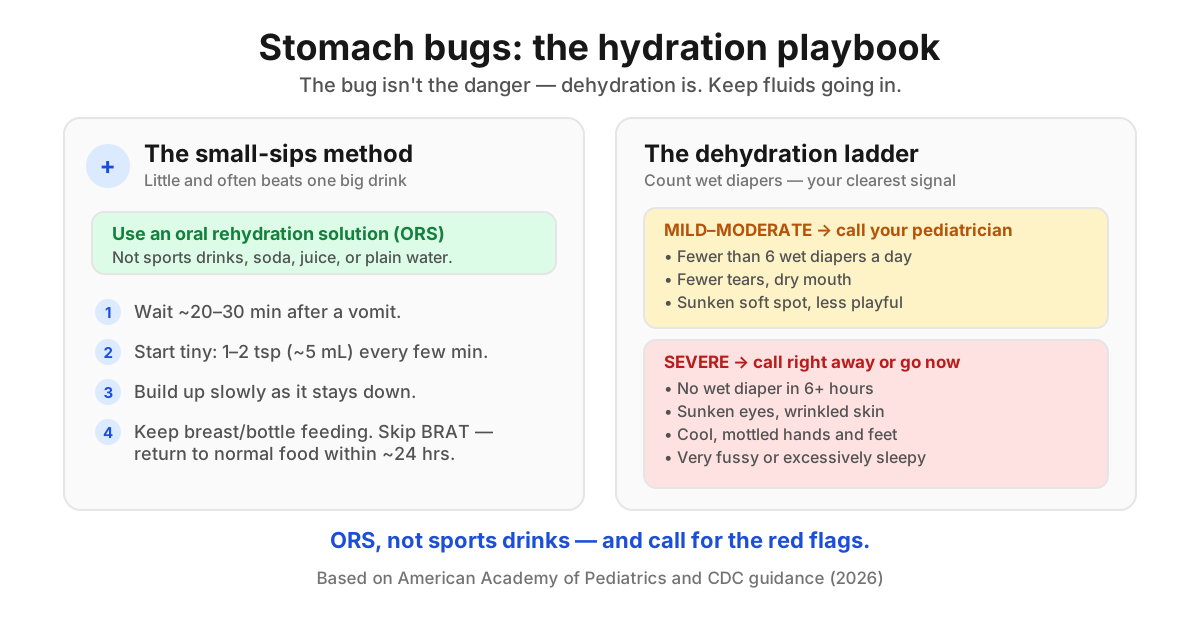
The right fluid is an oral rehydration solution (ORS) — the commercial products you'll see on the shelf, such as Pedialyte and store-brand equivalents. ORS is engineered with a specific, low-sugar, salt-balanced formula. The CDC's guidance on managing gastroenteritis in children recommends a reduced-osmolarity formula (roughly 75 mEq/L sodium and 75 mmol/L glucose) precisely because that balance pulls water and salt into the bloodstream efficiently — and, in studies, led to less vomiting and less stool output than older recipes.
Here's what not to reach for, and why:
- Sports drinks, soda, and full-strength juice have far too much sugar and the wrong salt balance. The extra sugar actually pulls more water into the gut and can make diarrhea worse, per the AAP.
- Plain water is the opposite problem — it has almost no salt, and for a small baby, too much plain water can dangerously dilute their sodium. Babies under 6 months should not be given plain water to rehydrate without a doctor's okay.
- Homemade salt-and-sugar mixes are risky to measure for an infant — a mistake in either direction matters. Use a commercial ORS when you can.
If your baby is still breastfeeding or formula-feeding, keep doing it. The CDC and AAP both stress that breastfeeding should continue through the whole illness, and full-strength formula is usually fine — you don't need to dilute it or switch to a special formula.
How to actually get the fluids in: small sips, often
A baby who just threw up cannot chug 6 ounces, and trying will trigger another round. The technique that works is small amounts, very frequently — a strategy the AAP's vomiting guidance is built around.
A practical rhythm many pediatricians suggest:
- Wait a short while after a vomiting episode — maybe 20 to 30 minutes — to let the stomach settle.
- Start tiny. Offer just a teaspoon or two (about 5 mL) of ORS every few minutes. A syringe, a spoon, or even small ice chips for older toddlers all work.
- Build up gradually as it stays down — slowly increasing the amount and stretching the interval over the next hour or two.
- If your baby vomits again, don't panic and don't give up — wait a bit longer, then go back to even smaller sips.
It feels painfully slow, but a steady teaspoon every few minutes adds up to real ounces over an hour — and it's far gentler on an angry stomach than one big drink. The AAP notes that most children need a liquid diet for only about 12 to 24 hours before they can ease back toward solids.
Food: forget the BRAT diet
For decades, parents were told to feed sick kids the BRAT diet — bananas, rice, applesauce, toast. That advice is out of date. The AAP now says BRAT foods are too low in fiber, protein, and fat to give a recovering child what they need, and they don't speed anything up.
Instead, once your child can keep fluids down and is asking for food, return to a normal, balanced, age-appropriate diet within about a day. For babies on solids, that means their usual foods. For older toddlers, regular meals are fine — you don't need to restrict to bland "sick foods," though it's reasonable to skip very greasy or super-sugary foods for a day or two. Fasting a child to "rest the stomach" isn't a treatment and can actually slow recovery. If you're navigating early eating in general, our guide to baby-led weaning vs. purées covers normal-day feeding once the bug has passed.
Dehydration: the signs that change the plan
Here is the part to read twice, because it's the whole reason this matters. Knowing the signs of dehydration tells you whether you're managing at home or calling for help.
Mild to moderate dehydration — call your pediatrician for guidance:
- Fewer than six wet diapers in a day
- Fewer tears when crying
- A dry, parched mouth
- A sunken soft spot (fontanelle) on the head
- Less playful, less active than usual
Severe dehydration — this is urgent; call right away or go to the ER:
- Urinating only once or twice a day, or no wet diaper in 6 or more hours
- Sunken eyes
- Cool, discolored, or mottled hands and feet
- Wrinkled skin
- Very fussy, or excessively sleepy and hard to rouse
Counting wet diapers is your single most useful tool — it's the clearest, earliest number you have. Many parents find it helps to jot down each diaper and each round of fluids during a bug; tracking it in the TinyWins app turns a chaotic sick day into a clear answer to the question your pediatrician will ask first: "When did they last pee?"
When to call now — no hesitation
For these, skip the home triage and call your pediatrician or seek emergency care:
- Any sign of severe dehydration from the list above — no wet diaper in 6+ hours, no tears, sunken eyes or soft spot, very sleepy or floppy, cool mottled hands and feet.
- Vomiting that won't stop — your child can't keep even small sips of fluid down over several hours.
- Blood in the vomit or stool, or vomit that is green or yellow-green (bile-colored) — this can signal a blockage and needs to be seen.
- A severe, swollen, or constantly painful belly, or pain concentrated in the lower right side.
- Signs of significant pain you can't soothe, or a baby who seems sick rather than just uncomfortable.
- A baby under 3 months with any fever of 100.4°F (38°C) or higher — in this age group, fever is always an emergency, full stop. See newborn fever: when to worry.
- High fever, signs of dehydration, or symptoms that drag on beyond what feels normal — when in doubt, call. That is exactly what your pediatrician is there for.
Most stomach bugs end the way they started — abruptly, a few miserable days later, with a kid who suddenly wants a snack and their favorite show. Your job in the meantime isn't to stop the bug; it's to keep the fluids going in, one small sip at a time, and to know the handful of signs that mean it's time to ask for backup. You've got this.
This article is educational and not medical advice. Always check with your pediatrician/provider.