Breastfeeding gets sold as the most natural thing in the world, which is technically true and also deeply unhelpful at 3 a.m. when one breast feels like a hot rock and you're googling with one thumb. Natural does not mean easy, and running into a problem is not a verdict on you or your baby.
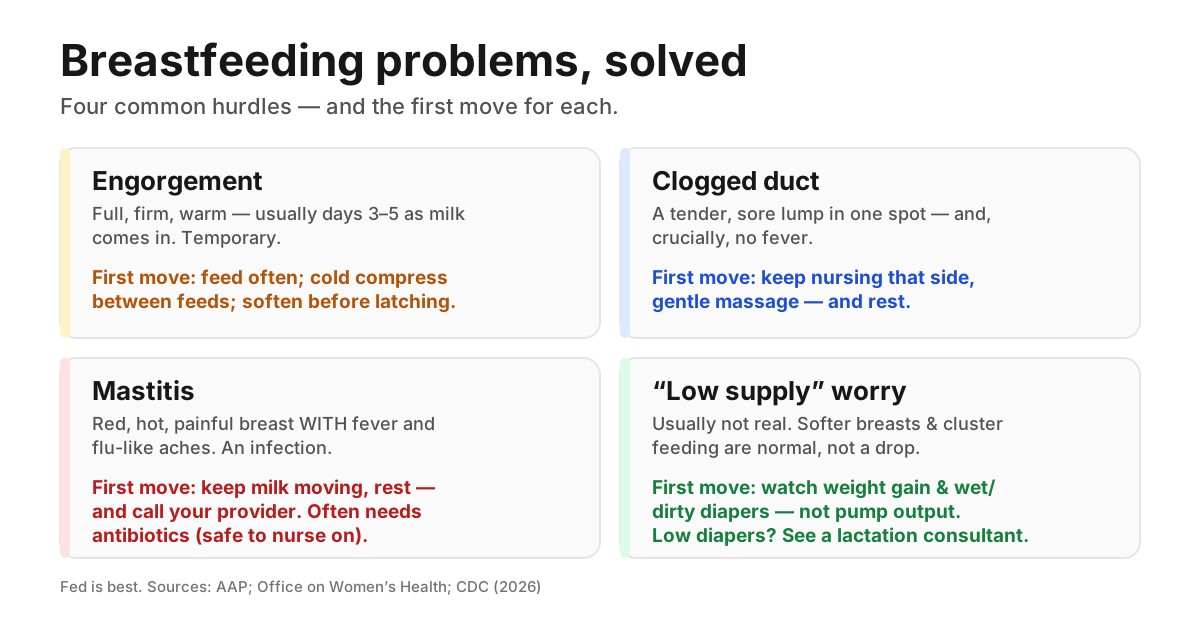
Here's the good news up front: the four hurdles that send parents searching at midnight — engorgement, clogged ducts, mastitis, and "is my supply low?" — are common, well understood, and almost always manageable. The through-line for nearly all of them is the same: keep milk moving, rest, and know the short list of signs that mean call your provider. Let's take them one at a time.
And before anything else: fed is best. Whether you breastfeed for two weeks or two years, exclusively or alongside formula, a fed baby and a well parent are the goal. If breastfeeding becomes a source of pain or despair, that's worth solving — and sometimes the solution is help, and sometimes it's a bottle. No guilt here. (If you land on formula, our formula feeding without guilt guide has your back.)
What the science says: it's mostly a plumbing problem
Most early breastfeeding troubles come down to milk supply meeting milk removal. When milk goes in faster than it comes out, you get fullness, then engorgement, then — if a spot stays backed up — a clog, and occasionally an infection. According to the Office on Women's Health, most parents make plenty of milk for their babies, and the system self-corrects as supply and demand calibrate over the first few weeks.
So the first move for almost every problem is the same: get the milk out, gently and often. The second is to make sure the latch is doing its job, because a deep latch is what removes milk efficiently and protects your nipples. If you're still dialing that in, start with breastfeeding latch basics — it solves a surprising share of "supply" and "pain" worries before they start.
Engorgement: full, firm, and temporary
In the first days after birth, your breasts may become larger, firm, warm, and genuinely uncomfortable as your mature milk comes in — typically around days 3 to 5, per the CDC. That's engorgement, and it's a sign your supply is ramping up, not a problem with your body.
The fix is to keep the breast emptying without over-stimulating even more production:
- Feed often — every 1.5 to 3 hours in those early days. Frequent feeding both relieves the pressure and prevents severe engorgement.
- Soften before latching. If the breast is so full and firm the baby can't latch, hand-express or pump just a little to soften the areola first. The Office on Women's Health describes reverse pressure softening — gently pressing inward around the areola to move fluid back — to make latching easier.
- Cold between feeds. A cold compress (or even chilled cabbage leaves, the classic) reduces swelling and pain between feeds.
- Don't pump it dry. Removing far more than the baby needs tells your body to make even more, which prolongs the cycle. Take the edge off; let the baby do the rest.
Engorgement usually eases within a few days as your supply and your baby's appetite find each other. This short Global Health Media Project film shows exactly what engorgement looks like and the gentle moves that relieve it:
Clogged ducts: the tender lump with no fever
A plugged (clogged) duct is a milk duct that's gotten backed up. It shows up as a tender, sore lump in one spot — and crucially, no fever. That fever line is the whole diagnosis: lump without fever is usually a clog; lump with fever and flu-like symptoms is heading toward mastitis (next section).
To clear it:
- Keep nursing or pumping on that side. Milk removal is the cure. Don't "rest" the breast — that makes it worse.
- Gentle warmth before, cold after. A warm compress before a feed can help milk let down; cold afterward calms inflammation. (Older advice to aggressively massage and heat has softened — be gentle, not vigorous.)
- Change positions so the baby's chin or nose points toward different areas of the breast across feeds, draining more ducts.
- And here's the underrated one — rest. As the Office on Women's Health puts it, a plugged duct is often a sign you're doing too much. Sit down. Hand the baby off. Let someone else fold the laundry.
If the lump hasn't budged in a couple of days, or fever and spreading redness appear, treat it as possible mastitis and call your provider.
Mastitis: when to drop everything and call
This is the one where we stop with the tips and get direct.
Mastitis is a breast infection, and it can move fast. The American Academy of Pediatrics describes it as swelling, warmth, burning, redness, or pain in one breast — often a wedge-shaped red area — usually with fever and flu-like symptoms (body aches, chills, feeling wiped out, like the flu hit you in one breast).
What to do:
- Call your provider promptly. If symptoms last beyond about 24 hours or are getting worse, you need to be seen — mastitis frequently requires antibiotics, and waiting lets it progress (occasionally to an abscess).
- Keep breastfeeding or pumping. This is the part that surprises people: you should keep milk moving from the affected breast. Per the AAP, continuing to nurse helps drain the breast and keeps the infection from worsening. If nursing on that side is too painful, feed from the other breast and pump or hand-express the affected one.
- Antibiotics are compatible with nursing. The AAP notes the antibiotics prescribed for mastitis generally don't cause problems for the nursing infant — and you should finish the full course. If you're not improving within about 72 hours, circle back to your provider.
- Rest, fluids, and pain relief. Rest isn't a luxury here; it's treatment. Stay hydrated and use a provider-approved pain reliever.
Mastitis is also a moment to check in on you, not just the breast. A high fever and feeling awful in the early postpartum weeks deserves attention on its own — and some warning signs aren't about breastfeeding at all. Know the postpartum recovery warning signs so you can tell a breast infection from something that needs the ER.
"I think my supply is low" (you probably don't)
This is the most common worry and the least often true. Most low-supply fears come from misreading normal signals:
- Softer breasts. Around 6 to 8 weeks, your breasts stop feeling full all the time. That's your supply regulating to your baby's needs — not drying up.
- Frequent feeding and fussiness. During growth spurts, babies nurse more often to drive supply up. Cluster feeding in the evening is normal and is how the system works, not a sign it's failing.
- "I can't pump much." A pump is not your baby. Plenty of people who feed beautifully pump very little. Pump output is a poor measure of supply.
So what does tell you the baby's getting enough? Output and growth. Watch for steady weight gain and enough wet and dirty diapers — those are the trustworthy signs. If those are on track, your supply is fine, full breasts or not.
When low supply is real — poor weight gain, too few diapers, signs of dehydration — it's worth acting on quickly. Don't white-knuckle it: a lactation consultant (IBCLC) can assess a feed in person, and your provider can rule out medical causes. And topping up with formula while you sort it out is a perfectly good bridge, not a failure. Fed is best, every time.
If you're tracking feeds and diapers to reassure yourself between pediatrician visits, the TinyWins app lets you log both in a few taps, so "is this normal?" becomes a pattern you can actually see — and bring to your next appointment.
When to call your provider
Most breastfeeding problems are solvable at home. Reach out to your provider or a lactation consultant when you see:
- Fever with breast pain, or a red, hot, hard area that isn't improving within about 24 hours — possible mastitis.
- Flu-like symptoms (chills, body aches, exhaustion) alongside breast pain.
- A lump that persists beyond a few days, or any sign redness is spreading.
- Cracked, bleeding, or severely painful nipples that aren't healing — usually a latch issue an IBCLC can fix.
- Signs your baby isn't getting enough: poor weight gain, far fewer wet/dirty diapers, lethargy, or fewer than expected feeds.
- Pain that makes you dread feeding. Breastfeeding can be uncomfortable as you learn, but ongoing pain is a signal, not a rite of passage — and it's fixable.
Breastfeeding has a steep learning curve and a short list of common potholes. Knowing what each one is — and that engorgement passes, clogs clear, mastitis is treatable, and "low supply" is usually a full and healthy supply in disguise — turns a 3 a.m. panic into a plan. Get the milk moving, rest more than feels reasonable, and never hesitate to ask for hands-on help.
This article is educational and not medical advice. Always check with your pediatrician/provider.